
SUPER RARE Original Vintage 1929 Art Deco Jigsaw Puzzle- R R Heywood Litho 9
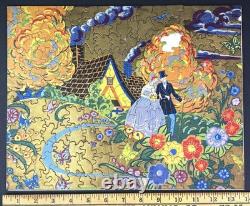
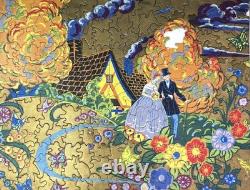
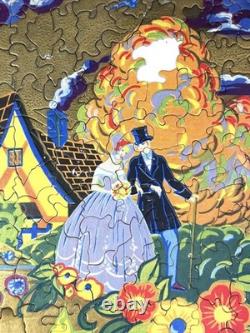
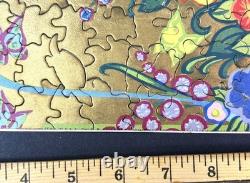
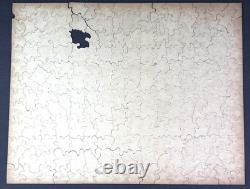

Gorgeous - SUPER RARE Original Jigsaw Puzzle. For offer, an beautiful old puzzle! Fresh from a prominent estate in Upstate NY.
Never offered on the market until now. Vintage, Old, Original, Antique, NOT a Reproduction - Guaranteed!! Scarce / Rare - I could not locate this puzzle or company anywhere. There was a Robert Heywood lithographer, and perhaps it is him.
Still, very little found on him. At bottom: Litho in U.
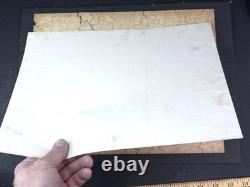
I have several other different ones I will be listing today, which all came together in a stack with paper separators in between. Those ones looks to be dated 1929. They are old, from an estate in Hammondsport, NY, and look to be used, but could be New old stock. I did not count, but would estimate 300-400 pieces.Comes with separate original white paper found in between each puzzle. P leas e see photos for all details. If you collect 20th century American art print history, Americana lithography, games / toys/ puzzles, this is a treasure you will not see again! Add this to your library, or paper / ephemera collection.
It is possible that the company later became Heywood Strasser and Voight Lithography Co. A jigsaw puzzle (with context, sometimes just jigsaw or just puzzle) is a tiling puzzle that requires the assembly of. Often irregularly shaped interlocking and mosaicked pieces. Typically each piece has a portion of a picture, which is completed by solving the puzzle. In the 18th century, jigsaw puzzles were created by painting a picture on a flat, rectangular piece of wood, then cutting it into small pieces. The name "jigsaw" derives from the tools used to cut the images into pieces-variably identified as jigsaws, fretsaws or scroll saws. Assisted by Jason Hinds, John Spilsbury, a London cartographer and engraver, is credited with commercialising jigsaw puzzles around 1760. His design took world maps, and cut out the individual nations in order for them to be reassembled by students as a geographical teaching aid. [1] They have since come to be made primarily of interlocking cardboard pieces, incorporating a variety of images and designs. Jigsaw puzzles have been used in research studies to study cognitive abilities such as mental rotation visuospatial ability in young children.Typical images on jigsaw puzzles include scenes from nature, buildings, and repetitive designs. Castles and mountains are among traditional subjects, but any picture can be used. Artisan puzzle-makers and companies using technologies for one-off and small print-run puzzles utilize a wide range of subject matter, including optical illusions, unusual art, and personal photographs. In addition to traditional flat, two-dimensional puzzles, three-dimensional puzzles have entered large-scale production, including spherical puzzles and architectural recreations. A range of jigsaw puzzle accessories, including boards, cases, frames, and roll-up mats, have become available to assist jigsaw puzzle enthusiasts.
While most assembled puzzles are disassembled for reuse, they can also be attached to a backing with adhesive and displayed as art. Competitive jigsaw puzzling has grown in popularity in the 21st century, with both regional and national competitions held in many countries, and annual World Jigsaw Puzzle Championships held from 2019. John Spilsbury's Europe divided into its kingdoms, etc. He created the jigsaw puzzle for educational purposes, and called them "Dissected Maps". John Spilsbury is believed to have produced the first jigsaw puzzle around 1760, using a marquetry saw. Early puzzles, known as dissections, were produced by mounting maps on sheets of hardwood and cutting along national boundaries, creating a puzzle useful for teaching geography. [1] Royal governess Lady Charlotte Finch used such "dissected maps" to teach the children of King George III and Queen Charlotte. [4][5] Cardboard jigsaw puzzles appeared in the late 1800s, but were slow to replace wooden ones because manufacturers felt that cardboard puzzles would be perceived as low-quality, and because profit margins on wooden jigsaws were larger. British printed puzzle from 1874. The name "jigsaw" came to be associated with the puzzle around 1880 when fretsaws became the tool of choice for cutting the shapes. [1] Along with fretsaws, jigsaws and scroll saws have also been noted as tools used to cut jigsaw puzzles into pieces. [6] The term "jigsaw puzzle" dates back to 1906. Wooden jigsaw pieces, cut by hand.Jigsaw puzzles first became a craze among adults in the United States from 1907 to 1910, and a year or two later in Europe. [7] These puzzles were typically made from solid wood, and were often non-interlocking, making them very challenging. [8] Adding to the challenge, there was usually no image on the box. Economy in 1907, increased participation of middle- and upper-class women in arts and crafts activities like puzzle making, and the introduction of the foot-powered scroll saw.
[7] Jigsaw puzzles also soared in popularity during the Great Depression, as they provided a cheap, long-lasting, recyclable form of entertainment. [1][9] It was around this time that jigsaws evolved to become more complex and appealing to adults. [1] They were also given away in product promotions and used in advertising, with customers completing an image of the promoted product. [1][9] Some of the largest makers of hand-cut wooden puzzles in the United States in the early 20th century included Pastime Puzzles (made by Parker Brothers), Milton Bradley Premier Puzzles, Par Puzzles, Madmar Puzzles, and J. Sales of wooden puzzles fell after World War II as improved wages led to price increases, while improvements in manufacturing processes made paperboard jigsaws more attractive.Demand for jigsaw puzzles saw a surge, comparable to that of the Great Depression, during the COVID-19 pandemic's stay-at-home orders. Most modern jigsaw puzzles are made of paperboard as they are easier and cheaper to mass-produce. An enlarged photograph or printed reproduction of a painting or other two-dimensional artwork is glued to cardboard, which is then fed into a press. The press forces a set of hardened steel blades of the desired pattern, called a puzzle die, through the board until fully cut.
The puzzle die is a flat board, often made from plywood, with slots cut or burned in the same shape as the knives that are used. The knives are set into the slots and covered in a compressible material, typically foam rubber, which ejects the cut puzzle pieces.
The cutting process is similar to making shaped cookies with a cookie cutter. However, the forces involved are tremendously greater. Beginning in the 1930s, jigsaw puzzles were cut using large hydraulic presses that now cost hundreds of thousands of dollars. The precise cuts gave a snug fit, but the cost limited jigsaw puzzle production to large corporations. Recent roller-press methods achieve the same results at a lower cost.
New technology has also enabled laser-cutting of wooden or acrylic jigsaw puzzles. The advantage is that the puzzle can be custom-cut to any size or shape, with any number or average size of pieces.Many museums have laser-cut acrylic puzzles made of some of their art so visiting children can assemble puzzles of the images on display. Acrylic pieces are very durable, waterproof, and can withstand continued use without the image degrading. Also, because the print and cut patterns are computer-based, missing pieces can easily be remade. By the early 1960s, Tower Press was the world's largest jigsaw puzzle maker; it was acquired by Waddingtons in 1969.
[12] Numerous smaller-scale puzzle makers work in artisanal styles, handcrafting and handcutting their creations. Jigsaw puzzle software allowing rotation of pieces.Jigsaw puzzles come in a variety of sizes. Among those marketed to adults, 300-, 500- and 750-piece puzzles are considered "smaller". More sophisticated, but still common, puzzles come in sizes of 1000, 1500, 2000, 3000, 4000 and 5000 pieces. Jigsaw puzzles geared towards children typically have significantly fewer pieces and are typically much larger. For very young children, puzzles with as few as 4 to 9 large pieces (so as not to be a choking hazard) are standard.
They are usually made of wood or plastic for durability and can be cleaned without damage. The most common layout for a thousand-piece puzzle is 38 pieces by 27 pieces, for an actual total of 1,026 pieces. Most 500-piece puzzles are 27 pieces by 19 pieces, for a total of 513 pieces. [citation needed] A few puzzles are double-sided so they can be solved from either side-adding complexity, as the enthusiast must determine if they are looking at the right side of each piece. "Family puzzles" of 100-550 pieces use an assortment of small, medium and large pieces, with each size going in one direction or towards the middle of the puzzle.
This allows a family of different skill levels and hand sizes to work on the puzzle together. Companies like Springbok, Cobble Hill, Ceaco, Buffalo Games and Suns Out make this type of specialty puzzle. Ravensburger, on the other hand, formerly made this type of puzzle from 2000 until 2008.
A three-dimensional puzzle composed of several two-dimensional puzzles stacked on top of one another. There are also three-dimensional jigsaw puzzles. Many are made of wood or styrofoam and require the puzzle to be solved in a particular order, as some pieces will not fit if others are already in place. One type of 3-D jigsaw puzzle is a puzzle globe, often made of plastic.
Like 2-D puzzles, the assembled pieces form a single layer, but the final form is three-dimensional. Most globe puzzles have designs representing spherical shapes such as the Earth, the Moon, and historical globes of the Earth. A puzzle without a picture.Jigsaw puzzles can vary significantly in price depending on their complexity, number of pieces, and brand. A "whimsy" piece in a wooden jigsaw puzzle.
Most puzzles are square or rectangular, with edge pieces with one straight side, and four corner pieces. However, some puzzles have edge and corner pieces cut like the rest, with no straight sides, making them more challenging to identify.
Some puzzles are round or in a more complex shape, such as profiles of animals, and their edge pieces are therefore curved. Spherical puzzles can have triangular edge pieces. Otherwise, all or most pieces of a modern jigsaw puzzle interlock by means of rounded tabs (interjambs) and indentations (called "blanks") on adjacent sides. The pieces are normally four-sided and may be uniform in appearance except for the edges and corners. Some puzzles are termed "fully interlocking", which means that a group of assembled pieces fit together tightly enough to be moved without falling apart; sometimes the connection is tight enough that a solved section will remain attached when lifted by one piece. Uniformly shaped fully interlocking puzzles, sometimes called "Japanese Style", are more difficult because pieces are hard to tell apart. Wooden puzzles fit together more loosely, with few tabs and blanks, because of the limits of the material and the cutting technology. They sometimes include pieces in recognisable shapes such as objects or animals, known as "whimsies", "silhouettes", or "figurals". [18] Designer Yuu Asaka has created monochrome jigsaw puzzles with five "corner" pieces (with two straight edges)[19] and consisting entirely of such pieces. [20] The former was awarded the Jury Honorable Mention at the 2018 Puzzle Design Competition.(grápho)'to write'[1] is a planographic method of printing originally based on the immiscibility of oil and water. [2] The printing is from a stone (lithographic limestone) or a metal plate with a smooth surface.
It was invented in 1796 by the German author and actor Alois Senefelder and was initially used mostly for musical scores and maps. [3][4] Lithography can be used to print text or images onto paper or other suitable material. [5] A lithograph is something printed by lithography, but this term is only used for fine art prints and some other, mostly older, types of printed matter, not for those made by modern commercial lithography. Traditionally, the image to be printed was drawn with a greasy substance, such as oil, fat, or wax onto the surface of a smooth and flat limestone plate. The stone was then treated with a mixture of weak acid and gum arabic ("etch") that made the parts of the stone's surface that were not protected by the grease more hydrophilic (water attracting).For printing, the stone was first moistened. The water adhered only to the etched, hydrophilic areas, making them even more oil-repellant.
An oil-based ink was then applied, and would stick only to the original drawing. The ink would finally be transferred to a blank sheet of paper, producing a printed page. This traditional technique is still used for fine art printmaking.In modern commercial lithography, the image is transferred or created as a patterned polymer coating applied to a flexible plastic or metal plate. [7] The printing plates, made of stone or metal, can be created by a photographic process, a method that may be referred to as "photolithography" (although the term usually refers to a vaguely similar microelectronics manufacturing process).
[8][9] Offset printing or "offset lithography" is an elaboration of lithography in which the ink is transferred from the plate to the paper indirectly by means of a rubber plate or cylinder, rather than by direct contact. This technique keeps the paper dry and allows fully automated high-speed operation. It has mostly replaced traditional lithography for medium- and high-volume printing: since the 1960s, most books and magazines, especially when illustrated in colour, are printed with offset lithography from photographically created metal plates. As a printing technology, lithography is different from intaglio printing (gravure), wherein a plate is engraved, etched, or stippled to score cavities to contain the printing ink; and woodblock printing or letterpress printing, wherein ink is applied to the raised surfaces of letters or images. During the early years of the 19th century, lithography had only a limited effect on printmaking, mainly because technical difficulties remained to be overcome. Germany was the main center of production in this period. Godefroy Engelmann, who moved his press from Mulhouse to Paris in 1816, largely succeeded in resolving the technical problems, and during the 1820s lithography was adopted by artists such as Delacroix and Géricault. After early experiments such as Specimens of Polyautography (1803), [16] which had experimental works by a number of British artists including Benjamin West, Henry Fuseli, James Barry, Thomas Barker of Bath, Thomas Stothard, Henry Richard Greville, Richard Cooper, Henry Singleton, and William Henry Pyne, London also became a center, and some of Géricault's prints were in fact produced there.Goya in Bordeaux produced his last series of prints by lithography-The Bulls of Bordeaux of 1828. By the mid-century the initial enthusiasm had somewhat diminished in both countries, although the use of lithography was increasingly favored for commercial applications, which included the prints of Daumier, published in newspapers. Rodolphe Bresdin and Jean-François Millet also continued to practice the medium in France, and Adolph Menzel in Germany.
In 1862 the publisher Cadart tried to initiate a portfolio of lithographs by various artists, which was not successful but included several prints by Manet. The revival began during the 1870s, especially in France with artists such as Odilon Redon, Henri Fantin-Latour and Degas producing much of their work in this manner. The need for strictly limited editions to maintain the price had now been realized, and the medium became more accepted. In the 1890s, color lithography gained success in part by the emergence of Jules Chéret, known as the father of the modern poster, whose work went on to inspire a new generation of poster designers and painters, most notably Toulouse-Lautrec, and former student of Chéret, Georges de Feure. By 1900 the medium in both color and monotone was an accepted part of printmaking.
During the 20th century, a group of artists, including Braque, Calder, Chagall, Dufy, Léger, Matisse, Miró, and Picasso, rediscovered the largely undeveloped artform of lithography thanks to the Mourlot Studios, also known as Atelier Mourlot, a Parisian printshop founded in 1852 by the Mourlot family. The Atelier Mourlot originally specialized in the printing of wallpaper; but it was transformed when the founder's grandson, Fernand Mourlot, invited a number of 20th-century artists to explore the complexities of fine art printing. Mourlot encouraged the painters to work directly on lithographic stones in order to create original artworks that could then be executed under the direction of master printers in small editions. The combination of modern artist and master printer resulted in lithographs that were used as posters to promote the artists' work.
Grant Wood, George Bellows, Alphonse Mucha, Max Kahn, Pablo Picasso, Eleanor Coen, Jasper Johns, David Hockney, Susan Dorothea White, and Robert Rauschenberg are a few of the artists who have produced most of their prints in the medium. Escher is considered a master of lithography, and many of his prints were created using this process. More than other printmaking techniques, printmakers in lithography still largely depend on access to good printers, and the development of the medium has been greatly influenced by when and where these have been established. [citation needed] An American scene for lithography was founded by Robert Blackburn in New York City. As a special form of lithography, the serilith or seriolithograph process is sometimes used.
Seriliths are mixed-media original prints created in a process in which an artist uses the lithograph and serigraph (screen printing). Fine art prints of this type are published by artists and publishers worldwide, and are widely accepted and collected. The separations for both processes are hand-drawn by the artist.
The serilith technique is used primarily to create fine art limited print editions. Art Deco, short for the French Arts décoratifs lit.
'Decorative Arts', [1] is a style of visual arts, architecture, and product design that first appeared in Paris in the 1910s just before World War I[2] and flourished internationally during the 1920s to early 1930s, through styling and design of the exterior and interior of anything from large structures to small objects, including clothing, fashion, and jewelry. Art Deco has influenced buildings from skyscrapers to cinemas, bridges, ocean liners, trains, cars, trucks, buses, furniture, and everyday objects, including radios and vacuum cleaners. The name Art Deco came into use after the 1925 Exposition internationale des arts décoratifs et industriels modernes (International Exhibition of Modern Decorative and Industrial Arts) held in Paris.
[4] It has its origin in the bold geometric forms of the Vienna Secession and Cubism. From the outset, Art Deco was influenced by the bright colors of Fauvism and the Ballets Russes, and the exoticized styles of art from China, Japan, India, Persia, ancient Egypt, and the Maya. In its time, Art Deco was tagged with other names such as style moderne, Moderne, modernistic, or style contemporain, and it was not recognized as a distinct and homogeneous style.During its heyday, Art Deco represented luxury, glamour, exuberance, and faith in social and technological progress. The movement featured rare and expensive materials such as ebony and ivory, and exquisite craftsmanship. It also introduced new materials such as chrome plating, stainless steel, and plastic. In New York, the Empire State Building, Chrysler Building, and other buildings from the 1920s and 1930s are monuments to the style.
The largest concentration of Art Deco architecture in the world is in Miami Beach, Florida. Art Deco became more subdued during the Great Depression. A sleeker form of the style appeared in the 1930s called Streamline Moderne, featuring curving forms and smooth, polished surfaces.
[7] Art Deco was an international style but, after the outbreak of World War II, it lost its dominance to the functional and unadorned styles of modern architecture and the International Style. Art Deco took its name, short for Arts Décoratifs, from the International Exhibition of Modern Decorative and Industrial Arts held in Paris in 1925.
[4] In France the distinction of arts décoratifs was first made in the 1858 Bulletin de la Société française de photographie. [9] In 1868, the Le Figaro newspaper used the term objets d'art décoratifs for objects for stage scenery created for the Théâtre de l'Opéra. [10][11][12] In 1875, furniture designers, textile, jewellers, glass-workers, and other craftsmen were officially given the status of artists by the French government. In 1920 the École nationale supérieure des arts décoratifs (ENSAD) was established.
The actual term Art déco did not appear in print until 1966, in the title of the first modern exhibition on the subject, held by the Museum of Decorative Arts in Paris, Les Années 25 : Art déco, Bauhaus, Stijl, Esprit nouveau, which covered a variety of major styles in the 1920s and 1930s. [13] The term was then used in a 1966 newspaper article by Hillary Gelson in The Times, describing the different styles at the exhibit. Art Deco gained currency as a broadly applied stylistic label in 1968 when historian Bevis Hillier published the first major academic book on it, Art Deco of the 20s and 30s. [3] He noted that the term was already being used by art dealers, and cites The Times (2 November 1966) and an essay named Les Arts Déco in Elle magazine (November 1967) as examples.
[15] In 1971, he organized an exhibition at the Minneapolis Institute of Arts, which he details in his book The World of Art Deco. New materials and technologies, especially reinforced concrete, were key to the development and appearance of Art Deco. The first concrete house was built in 1853 in the Paris suburbs by François Coignet.
In 1877, Joseph Monier introduced the idea of strengthening the concrete with a mesh of iron rods in a grill pattern. In 1893, Auguste Perret built the first concrete garage in Paris, then an apartment building, a house, then, in 1913, the Théâtre des Champs-Élysées. The theatre was denounced by one critic as the "Zeppelin of Avenue Montaigne", an alleged Germanic influence, copied from the Vienna Secession. Thereafter, the majority of Art Deco buildings were made of reinforced concrete, which gave greater freedom of form and less need for reinforcing pillars and columns. Perret was also a pioneer in covering the concrete with ceramic tiles, both for protection and decoration.
The architect Le Corbusier first learned the uses of reinforced concrete while working as a draftsman in Perret's studio. Other new technologies that were important to Art Deco were new methods in producing plate glass, which was less expensive and allowed much larger and stronger windows, and for mass-producing aluminium, which was used for building and window frames and later, by Corbusier, Warren McArthur, and others, for lightweight furniture. The architects of the Vienna Secession (formed 1897), especially Josef Hoffmann, had a notable influence on Art Deco.
This became the model for the Compagnie des arts français, created in 1919, which brought together André Mare and Louis Süe, the first leading French Art Deco designers and decorators. The emergence of Art Deco was closely connected with the rise in status of decorative artists, who until late in the 19th century were considered simply artisans. The term arts décoratifs was used in France as the status of decorative arts rose, and in 1875 furniture designers, textile makers, and other craftsmen were officially recognized as artists by the French government.
[21] In 1901, the Société des artistes décorateurs (Society of Decorative Artists), or SAD, was founded, and decorative artists were given the same rights of authorship as painters and sculptors. A similar movement developed in Italy.
In 1902, the first international exhibition devoted entirely to the decorative arts, the Esposizione Internazionale d'Arte Decorativa Moderna, was held in Turin. Several new magazines devoted to decorative arts were founded in Paris, including Arts et décoration and L'Art décoratif moderne. Decorative arts sections were introduced into the annual salons of the Sociéte des artistes français, and later in the Salon d'Automne.
French nationalism also played a part in the resurgence of decorative arts, as French designers felt challenged by the increasing exports of less expensive German furnishings. In 1911, SAD proposed a major new international exposition of decorative arts in 1912. No copies of old styles would be permitted, only modern works.
The exhibit was postponed until 1914; and then, because of the war, until 1925, when it gave its name to the whole family of styles known as "Déco". Parisian department stores and fashion designers also played an important part in the rise of Art Deco. Prominent businesses such as silverware firm Christofle, glass designer René Lalique, and the jewellers Louis Cartier and Boucheron began designing products in more modern styles. [23][24] Beginning in 1900, department stores recruited decorative artists to work in their design studios.The decoration of the 1912 Salon d'Automne was entrusted to the department store Printemps, [25][26] and that year it created its own workshop, Primavera. By 1920, Primavera employed more than 300 artists, whose styles ranged from updated versions of Louis XIV, Louis XVI, and especially Louis Philippe furniture made by Louis Süe and the Primavera workshop, to more modern forms from the workshop of the Au Louvre department store.
Other designers, including Émile-Jacques Ruhlmann and Paul Follot, refused to use mass production, insisting that each piece be made individually. The early Art Deco style featured luxurious and exotic materials such as ebony, ivory and silk, very bright colours and stylized motifs, particularly baskets and bouquets of flowers of all colours, giving a modernist look. Display of early Art Deco furnishings by the Atelier français at the 1913 Salon d'Automne from Art et décoration magazine (1914). At its birth between 1910 and 1914, Art Deco was an explosion of colours, featuring bright and often clashing hues, frequently in floral designs, presented in furniture upholstery, carpets, screens, wallpaper and fabrics. Many colourful works, including chairs and a table by Maurice Dufrêne and a bright Gobelin carpet by Paul Follot were presented at the 1912 Salon des artistes décorateurs. [28] The furniture designers Louis Süe and André Mare made their first appearance at the 1912 exhibit, under the name of the Atelier français, combining polychromatic fabrics with exotic and expensive materials, including ebony and ivory. After World War I, they became one of the most prominent French interior design firms, producing the furniture for the first-class salons and cabins of the French transatlantic ocean liners. The vivid hues of Art Deco came from many sources, including the exotic set designs by Léon Bakst for the Ballets Russes, which caused a sensation in Paris just before World War I. Some of the colours were inspired by the earlier Fauvism movement led by Henri Matisse; others by the Orphism of painters such as Sonia Delaunay;[30] others by the movement known as Les Nabis, and in the work of symbolist painter Odilon Redon, who designed fireplace screens and other decorative objects.Bright shades were a feature of the work of fashion designer Paul Poiret, whose work influenced both Art Deco fashion and interior design. This work represents one of the earliest examples of what became known as Art Deco sculpture. Previously, reinforced concrete was only used for industrial and apartment buildings, Perret had built the first modern reinforced-concrete apartment building in Paris on rue Benjamin Franklin in 1903-04. Henri Sauvage, another important future Art Deco architect, built another in 1904 at 7, rue Trétaigne (1904).
From 1908 to 1910, the 21-year-old Le Corbusier worked as a draftsman in Perret's office, learning the techniques of concrete construction. Perret's building had clean rectangular form, geometric decoration and straight lines, the future trademarks of Art Deco.The décor of the theatre was also revolutionary; the façade was decorated with high reliefs by Antoine Bourdelle, a dome by Maurice Denis, paintings by Édouard Vuillard, and an Art Deco curtain by Ker-Xavier Roussel. The theatre became the venue for many of the first performances of the Ballets Russes. [33] Perret and Sauvage became the leading Art Deco architects in Paris in the 1920s.
The art movement known as Cubism appeared in France between 1907 and 1912, influencing the development of Art Deco. [33][30][31] In Art Deco Complete: The Definitive Guide to the Decorative Arts of the 1920s and 1930s Alastair Duncan writes Cubism, in some bastardized form or other, became the lingua franca of the era's decorative artists. [31][36] The Cubists, themselves under the influence of Paul Cézanne, were interested in the simplification of forms to their geometric essentials: the cylinder, the sphere, the cone. In 1912, the artists of the Section d'Or exhibited works considerably more accessible to the general public than the analytical Cubism of Picasso and Braque.
The Cubist vocabulary was poised to attract fashion, furniture and interior designers. In the Art Décoratif section of the 1912 Salon d'Automne, an architectural installation was exhibited known as La Maison Cubiste. [40][41] The façade was designed by Raymond Duchamp-Villon. The décor of the house was by André Mare. [42][43] La Maison Cubiste was a furnished installation with a façade, a staircase, wrought iron banisters, a bedroom, a living room-the Salon Bourgeois, where paintings by Albert Gleizes, Jean Metzinger, Marie Laurencin, Marcel Duchamp, Fernand Léger and Roger de La Fresnaye were hung. [44][45][46] Thousands of spectators at the salon passed through the full-scale model. The façade of the house, designed by Duchamp-Villon, was not very radical by modern standards; the lintels and pediments had prismatic shapes, but otherwise the façade resembled an ordinary house of the period. For the two rooms, Mare designed the wallpaper, which featured stylized roses and floral patterns, along with upholstery, furniture and carpets, all with flamboyant and colourful motifs.It was a distinct break from traditional décor. The critic Emile Sedeyn described Mare's work in the magazine Art et Décoration: He does not embarrass himself with simplicity, for he multiplies flowers wherever they can be put. The effect he seeks is obviously one of picturesqueness and gaiety.
[48] The Cubist element was provided by the paintings. The installation was attacked by some critics as extremely radical, which helped make for its success. [49] This architectural installation was subsequently exhibited at the 1913 Armory Show, New York City, Chicago and Boston. [30][38][50][51][52] Thanks largely to the exhibition, the term "Cubist" began to be applied to anything modern, from women's haircuts to clothing to theater performances. The Cubist influence continued within Art Deco, even as Deco branched out in many other directions.Cubism's adumbrated geometry became coin of the realm in the 1920s. Art Deco's development of Cubism's selective geometry into a wider array of shapes carried Cubism as a pictorial taxonomy to a much broader audience and wider appeal. (Richard Harrison Martin, Metropolitan Museum of Art)[53].